

How to Create Flashcards: Rules, Examples, and AI Workflows
 EducateAI Editorial Team
Most flashcard guides fail for the same reason: they focus on the tool before they fix the card design.
The real question is not whether you use paper cards, Anki, Quizlet, or an AI workflow. The real question is whether each card gives you a clean retrieval task.
Use this guide if you want to:
- write cards that are actually testable
- turn notes or PDFs into better prompts
- avoid vague, overloaded, low-value cards
- use AI to speed up drafting without weakening learning
The goal is simple: fewer bad cards, more useful reviews, and better long-term retention.
Quick Start: The Minimum Good Flashcard Workflow
If you do not want the theory first, use this baseline:
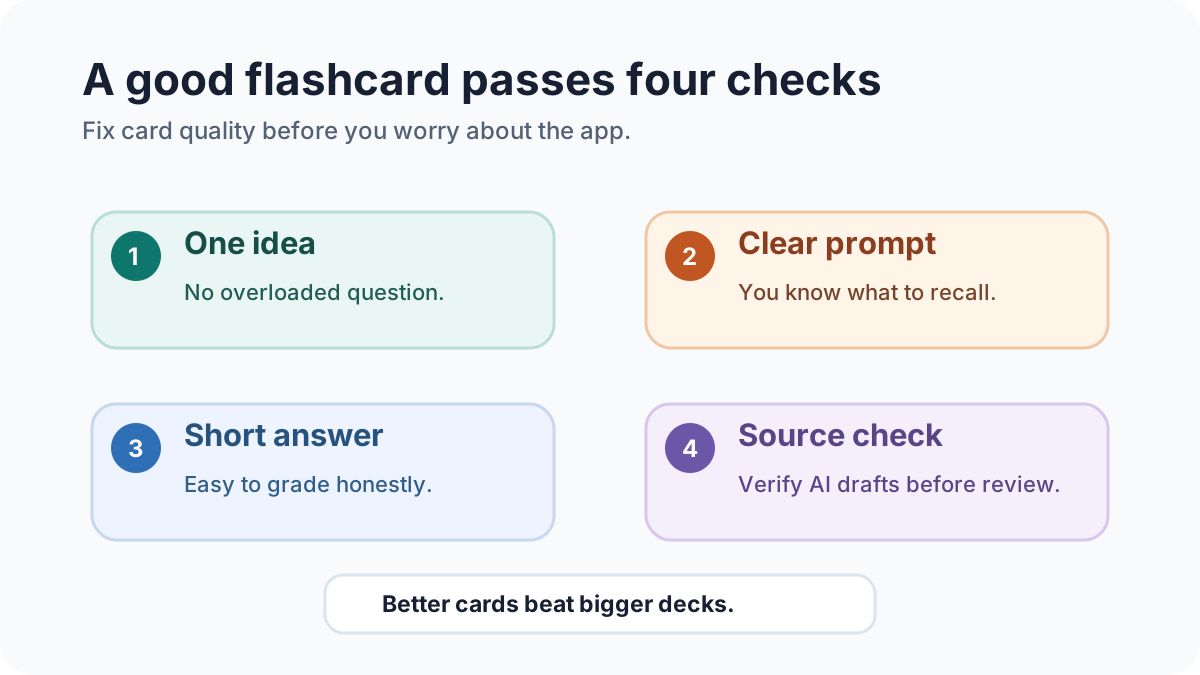
- Pick one concept, fact, process, or distinction per card.
- Write the prompt so it forces recall, not recognition.
- Keep the answer short enough that you can tell whether you truly knew it.
- Review weak cards and rewrite them instead of memorizing around bad phrasing.
- If you use AI, verify and simplify every generated card before studying it.
If you want one concrete end-to-end example, start with From Lecture Pack to Flashcards. If your exam prep already revolves around old questions, pair this guide with How to Study From Past Papers.
The Scientific Foundation: Why Flashcards Are So Effective
Understanding the Ebbinghaus Forgetting Curve
Hermann Ebbinghaus revolutionized our understanding of memory in 1885 with his famous forgetting curve. Modern memory research supports the core lesson behind it: without retrieval and review, recall drops fast. That is why traditional cramming often feels productive in the moment but fails a few days later.
Flashcards break this vicious cycle through strategically planned repetitions. When you successfully retrieve information for the first time, the interval until the next repetition extends. This principle of distributed repetition is the reason Spaced Repetition works so well in flashcard systems: the review schedule matters almost as much as the card itself.
Cognitive Load Theory: Optimally Using Working Memory
John Sweller's Cognitive Load Theory explains why flashcards are so effective: Our working memory can only process 7±2 information units simultaneously1. Traditional learning methods often overload this system with too much information at once.
Flashcards respect this limitation by breaking complex information into digestible chunks. A well-designed flashcard presents exactly one information unit, minimizing cognitive load and optimizing learning.
The Testing Effect: Retrieval Strengthens Memory
The act of retrieval matters more than passive repetition. When you try to remember something before seeing the answer, you make the memory trace work. That is the mechanism flashcards are trying to exploit.
Research on retrieval practice consistently shows the same pattern: testing yourself tends to produce stronger long-term retention than rereading alone2.
Neuroplasticity: How Flashcards Change the Brain
The Generation Effect helps explain why self-created or heavily edited cards often work better than copied ones3. If AI drafts your cards, you still improve the outcome by checking, trimming, and rewriting the weak parts yourself.
The 5 Golden Rules for Effective Flashcards
Rule 1: One Concept per Card – The Power of Focus
The most common trap when creating flashcards is the temptation to pack too much information onto one card. An effective flashcard deals exclusively with a single concept, fact, or connection.
Wrong: "What are the causes, symptoms, and treatment methods of diabetes mellitus?" Right: "Which three main symptoms characterize diabetes mellitus type 1?" (Answer: Polyuria, polydipsia, polyphagia)
This focus enables your brain to strengthen specific neural connections without being distracted by competing information.
Rule 2: Strategic Use of Visual Elements and Mnemonics
Visual elements help when they remove ambiguity or make a distinction easier to remember. Use images and mnemonics when they clarify the retrieval task, not to decorate weak cards.
For medical terms, a card could use the acronym "VITAMIN C" for causes of anemia: Voss (bleeding), Intake (iron deficiency), Transport (transferrin deficiency), Absorption (malabsorption), Metabolism (chronic diseases), Infection, Neoplasia, Chemicals.
Rule 3: Personal Examples – Make It Relevant
Abstract concepts come alive through personal connections. When you learn the concept of "conditioning," create a card that connects Pavlov's dogs with your own experience: "How do I react when my phone rings?" Personal relevance makes the card easier to retrieve because it hooks the idea to something you already know.
Rule 4: Active Formulation – Challenge Yourself
Passive cards like "What is photosynthesis?" often lead to superficial memorization. Active formulations demand deeper understanding: "Explain why plants cannot produce glucose without CO₂" or "Describe electron transport in photosynthesis in your own words."
Rule 5: Systematic Repetition Intervals – Timing Makes the Difference
Good review spacing is adaptive, not rigid. Easy cards should move out. Difficult cards should come back sooner. You do not need to manage that manually if your app already adjusts review timing based on performance4.
Modern Methods in Detail: From Analog to Digital
Cornell Notes Method Integration – Structured Learning
The integration of the Cornell Notes Method with flashcards creates a powerful learning cycle. During a lecture, you create Cornell Notes with the traditional three-column structure. The "Cue" column later becomes the front of your flashcards, while the notes column provides the answers.
Practical approach:
- Take Cornell Notes during the lecture
- Review the notes within 24 hours
- Convert cue questions into flashcards
- Add the summary as context cards
Mind Map to Flashcard Conversion – Networking Knowledge
Mind maps are excellent for understanding complex relationships but impractical for repetition. Converting to flashcards solves this problem elegantly:
Step 1: Create a comprehensive mind map of your topic Step 2: Identify every connection path between main branches Step 3: Convert each connection into its own flashcard Step 4: Create "overview cards" that query the big picture
AI-Assisted Generation – The Future of Flashcards
Modern AI tools can analyze complex texts and draft flashcards quickly. That is useful when your real bottleneck is turning notes, PDFs, or textbook sections into a first pass of review material.
Useful AI advantages:
- faster first drafts from notes, slides, and PDFs
- cleaner conversion from source material into question form
- easier identification of missing examples or vague prompts
- fewer manual copy-and-paste steps
The important question is not which chatbot has the cheapest plan. The important question is whether the generated cards are specific, accurate, and worth reviewing.
The real gain comes when AI fits into a source-grounded loop instead of replacing it. For one concrete example, read From Lecture Pack to Flashcards. If your current bottleneck is messy input files, continue with How to Study From Scanned PDFs and Lecture Slides. When you want the product workflow, use the AI flashcard maker for PDFs and notes.
Multimedia Cards – Activating All Senses
Modern digital platforms enable the integration of audio, video, and interactive elements. For language learning, you can embed native pronunciation recordings. For natural sciences, you can attach diagrams, structures, or worked examples that would be clumsy on paper.
Audio cards: Perfect for music theory, languages, or phonetic distinctions Video cards: Ideal for movement sequences in sports or medical procedures Interactive cards: Enable manipulation of diagrams or formulas
Collaborative Card Creation – Learning in Community
Group learning through shared card decks uses the wisdom of the crowd. Different learners bring different perspectives and insights, leading to rich, multi-layered flashcards.
Best practices for collaboration:
- Define clear quality standards
- Implement peer review processes
- Use rating systems for card quality
- Establish regular feedback cycles
Collaboration only works if someone owns quality control. Shared decks fail fast when nobody removes vague prompts, duplicate cards, or wrong answers.
Subject-Specific Strategies: Tailored Approaches
Different subjects need different card styles. The structure that works for anatomy is not the same structure that works for case law, grammar, or formulas.
Languages: Contextual Sentences Instead of Isolated Vocabulary
Traditional vocabulary cards with isolated word translations are inefficient. Instead, use contextual sentences that demonstrate natural language use.
Traditional: "casa = house" Effective: "Mi casa es tu casa" → "My house is your house" (with context of hospitality)
Advanced techniques:
- Collocation cards: "strong coffee" vs. "starker Kaffee"
- Idiom cards with cultural context
- Conjugation patterns in different tenses
- Phonetic transcription for pronunciation
Natural Sciences: Formula Cards with Application Context
Pure formula memorization without understanding is useless. Effective science cards link formulas with practical applications and conceptual connections.
Physics example: Front: "A car accelerates from 0 to 100 km/h in 8 seconds. Which formula do you use for acceleration?" Back: "a = (v₂ - v₁) / t → a = (27.8 - 0) / 8 = 3.47 m/s²"
Chemistry strategies:
- Reaction mechanism cards with electron movements
- Periodic table trends with justifications
- Acid-base reactions with pH calculations
History: Timeline Cards and Causal Connections
Historical learning requires understanding cause-and-effect relationships and chronological connections.
Timeline cards: "What happened between the invention of printing (1440) and the Reformation (1517)?" Answer should show connections between technological and religious developments.
Causality cards: "Which three factors led to the outbreak of World War I?" Focus on complex causal networks rather than simple triggers.
Medicine: Diagnostic Trees and Symptom Clusters
Medical flashcards must promote clinical thinking, not just convey factual knowledge.
Differential diagnosis cards: "Patient presents chest pain, dyspnea, and diaphoresis. Which three differential diagnoses must be immediately ruled out?" Answer: Myocardial infarction, pulmonary embolism, pneumothorax
Symptom cluster cards: "Which symptom constellation characterizes diabetic ketoacidosis?" Integration of laboratory values, clinical signs, and pathophysiology.
Avoiding Common Mistakes: The Biggest Pitfalls
Information Overload: Less Is More
The attempt to pack too much information onto a single card is the most common and serious mistake. An overloaded card with multiple concepts prevents the focused memory formation that makes flashcards so effective.
Symptoms of overloaded cards:
- Answers longer than 2-3 sentences
- Multiple concepts in one question
- Confusing layout with too many visual elements
- Unclear question focus
Solution: Break complex information into atomic units – small, indivisible knowledge units that each strengthen a specific connection in memory.
Poor Question Formulation: Precision Is Crucial
Vague or ambiguous questions lead to frustrating learning experiences and inefficient memory training.
Problematic formulations:
- "What do you know about X?" (too general)
- "True or false: Y is important" (too simple)
- Questions with multiple correct answers without specification
Improved formulations:
- "Name three specific mechanisms by which X influences process Y"
- "Compare X and Y regarding their effects on Z"
Irregular Repetition: Timing Destroys Efficiency
Inconsistent repetition rhythms undermine the benefits of distributed repetition. Sporadic learning leads to frustrating "I knew it yesterday" experiences.
Common timing errors:
- Too frequent repetition of already mastered cards
- Too infrequent repetition of difficult concepts
- Ignoring optimal repetition intervals
- Learning only before exams (cramming)
Missing Context: Isolated Knowledge Remains Useless
Flashcards without sufficient context promote superficial memorization without understanding. Isolated facts are hard to retrieve and poorly applicable.
Context deficiency signals:
- Facts without connection to larger concepts
- Missing application examples
- No justifications for "why" questions
- Lack of connection to prior knowledge
Frequently Asked Questions
1. How many flashcards should I create daily?
Quality trumps quantity. Ten usable cards are better than fifty vague ones. If you are new to flashcards, start small enough that you can still review, edit, and keep the deck clean.
2. When is the best time for flashcard repetitions?
The best time is the time you can sustain. Short, repeatable sessions usually beat occasional marathon reviews. If you can, separate new cards from review so the session does not turn into endless card creation.
3. Should I use physical or digital flashcards?
Both have advantages: Physical cards offer tactile experiences and no screen distractions. Digital cards enable automated spaced repetition, multimedia integration, and everywhere-available synchronization. Choose based on your learning style and technical preferences.
4. How do I handle very difficult cards that I keep forgetting?
Difficult cards often signal conceptual gaps. Strategies: 1) Break the card into smaller units, 2) Add mnemonic aids, 3) Connect with already known knowledge, 4) Create "bridge cards" that explain connections, 5) Temporarily shorten repetition intervals.
5. Can I use flashcards for creative subjects like art or literature?
Absolutely. The key is to test recognition, comparison, and interpretation instead of reducing everything to isolated facts. Art history cards can compare two works. Literature cards can test symbolism, motifs, or argument structure. Music cards can pair audio with style, period, or technique.
6. How do I integrate flashcards into my existing learning routine?
Use flashcards as one layer of the workflow, not the whole workflow. A practical version looks like this: 1) process one lecture pack or one topic, 2) turn the important misses into cards, 3) review them regularly, 4) test yourself again in writing or with past-paper questions. If you want a concrete example of that loop, read From Lecture Pack to Flashcards.
7. What role does AI play in modern flashcard creation?
AI is most useful at the draft stage. It can turn notes, slides, or PDFs into a first pass of questions much faster than manual copying. It is much less useful if you expect it to replace judgment. You still need to remove vague prompts, split overloaded cards, and check answers against the source material.
8. How do I measure the success of my flashcard strategy?
Success measurement through quantitative and qualitative metrics: 1) Retention rate after various time intervals, 2) Response speed as indicator of automation, 3) Transfer performance in exams and practical applications, 4) Subjective confidence in learned material. Modern apps offer detailed analytics for data-based optimization.
Conclusion: Better Cards Beat Bigger Decks
The biggest flashcard mistake is not using the wrong app. It is creating too many weak cards and then calling the deck a study system.
Strong flashcards are narrow, answerable, and easy to revisit. That matters more than perfect formatting or advanced settings. If you use AI, use it to save time on the first draft, then do the real work: cut, clarify, and review.
If you want to go deeper from here, continue with:
- From Lecture Pack to Flashcards
- How to Turn Lecture Notes Into Flashcards
- How to Study From Past Papers
- Exam Prep Hub
- Flashcards Hub
Turn one PDF or lecture note into a small study deck
If you already have notes, the fastest test is not another template. Upload one real source, generate a draft deck, then edit the weak cards before you start reviewing.
References
Further Reading
Scientific Sources:
- Bjork, R. A., & Bjork, E. L. (2020). Desirable difficulties in theory and practice. Journal of Applied Research in Memory and Cognition, 9(4), 475-479. DOI: 10.1016/j.jarmac.2020.09.003
- Carpenter, S. K. (2012). Testing enhances the transfer of learning. Current Directions in Psychological Science, 21(5), 279-283. DOI: 10.1177/0963721412452728
- Kornell, N., & Bjork, R. A. (2008). Learning concepts and categories: Is spacing the "enemy of induction"? Psychological Science, 19(6), 585-592. DOI: 10.1111/j.1467-9280.2008.02127.x
Practical Guides:
Transparency Notice
This article was researched and structured using AI tools, then edited and reviewed for publication. Time-sensitive product information such as pricing and model access should always be checked on the official provider pages.
Methodological Notes
- The cited studies use different methodologies and sample sizes
- Effect sizes may vary by subject area and individual learning styles
- AI tools are continuously evolving; check official sites for current pricing and feature access
- The effectiveness of learning methods depends on consistent application
Footnotes
Miller, G. A. (1956). The magical number seven, plus or minus two. Psychological Review, 63(2), 81-97. DOI: 10.1037/h0043158 ↩
Karpicke, J. D., & Blunt, J. R. (2011). Retrieval Practice Produces More Learning than Elaborative Studying with Concept Mapping. Science, 331(6018), 772-775. DOI: 10.1126/science.1199327 ↩
Slamecka, N. J., & Graf, P. (1978). The generation effect: Delineation of a phenomenon. Journal of Experimental Psychology, 4(6), 592-604. DOI: 10.1037/0278-7393.4.6.592 ↩
Tabibian, B., et al. (2019). Enhancing human learning via spaced repetition optimization. PNAS, 116(10), 3988-3993. DOI: 10.1073/pnas.1815156116 ↩
Was this article useful?
One click helps us improve future guides.
Related Articles

From Lecture Pack to Flashcards: a Cited Study Loop You Can Reuse
A concrete study workflow for turning one lecture pack into cited answers, tighter flashcards, and review sessions that stay tied to your source material.

How to Study From Past Papers: a Cited Q&A + Weak-Topic Deck Workflow
Turn past papers into a practical exam-prep loop: identify recurring question types, check answers against your course files, and build weak-topic decks.

How to Turn Lecture Notes Into Flashcards: Cornell Notes, Slides, and PDFs
A practical workflow for turning lecture notes, slides, and PDFs into clean flashcards without drowning in card creation.